Professional Iguana Removal in Delray Beach, FL
Trusted iguana removal experts serving Delray Beach residents and businesses. FWC listed wildlife specialist with proven results. We've helped Atlantic Avenue restaurants, Ocean Boulevard estates, historic Marina District homes, and 55+ communities throughout Delray Beach eliminate iguana problems.
Iguana Activity in Delray Beach
Delray Beach is built on three very different landscapes stitched together along Atlantic Avenue, and the iguana problem looks different in each one. Understanding that division is the only way to make sense of why a Marina District bungalow, a Kings Point villa, and an Ocean Boulevard beachfront house can all sit inside the same city limits and yet require almost completely different removal approaches.
The eastern third of the city — the barrier island east of the Intracoastal, including Ocean Boulevard estates, the Seagate Beach Club corridor, and the Tropic Isle peninsula — operates as Delray's beach zone. Iguanas here arrive primarily by water, swimming the Intracoastal and traveling along the dune line and the bayfront seawalls. The animals that establish on Ocean Boulevard properties tend to be larger adult males, drawn to the combination of mature sea grape, bougainvillea, and the warm thermal mass of poured-concrete pool decks. Tropic Isle, with its finger canals running off the Intracoastal, sees a different pattern again — every canal stub is its own small iguana corridor, and the iguanas and canal systems overview explains why finger-canal communities tend to hold higher resident iguana counts than open-water frontage.
The central wedge — Atlantic Avenue from Swinton west to about Congress, plus Pineapple Grove, the Marina Historic District, Old School Square, Del-Ida Park, and the Lake Ida neighborhoods — is Delray's downtown and historic-bungalow zone. The pressure here is fundamentally different. Lots are smaller, the canopy is dense and 70-to-100-year-old, very few homes have screen pool enclosures, and the iguanas live primarily in the trees and the gaps under raised foundations and detached garages. Atlantic Avenue itself is a hospitality-driven corridor — sidewalk cafés, courtyard restaurants, boutique hotels — which adds a commercial-overnight dimension we don't see at this scale anywhere else in our service area.
The western third, west of I-95, is Delray's country-club and 55+ community belt. Kings Point alone is roughly 7,000 units across 700 acres with extensive interconnected lakes; Hunters Run, Huntington Pointe, Delray Dunes, the Hamlet, Country Club of Florida, Mizner Country Club, Polo Trace, Gleneagles, and the Lakes of Delray sit in the same belt and share the same problem profile — large lake systems fed by the Lake Worth Drainage District canal grid, dense ornamental landscaping around clubhouses and entries, and shared common areas where one property's iguana management directly affects the next address over.
What ties all three zones together is the Lake Worth Drainage District canal system. The L-30, L-32, L-33, L-36, and E-3/E-4 canals form a continuous east-west and north-south grid across the city, connecting the western 55+ communities to the central downtown to the Intracoastal and the beach. A green iguana hatched on a Polo Trace lake bank can — and does — work its way across that grid into Lake Ida, into the Marina District, and eventually onto an Ocean Boulevard seawall, all without ever crossing a major road. The result is that no neighborhood in Delray is genuinely isolated, and "iguana-free" is not a state any property here can reach without active management.
Atlantic Avenue & Pineapple Grove Hospitality Iguana Removal
Atlantic Avenue is the highest-density restaurant corridor in southern Palm Beach County, and that density creates an iguana-management problem we don't see at the same scale anywhere else we work. From Swinton Avenue east to A1A, plus the Pineapple Grove arts district running north of Atlantic, dozens of restaurants and boutique hotels operate sidewalk cafés, interior courtyards, rooftop bars, and outdoor dining patios that effectively function as nighttime iguana banquet halls.
The animals find these properties for predictable reasons. Patio plantings (bougainvillea, hibiscus, ixora) provide overnight cover and food. Spilled and dropped food from dinner service stays accessible until morning cleanup crews arrive. Trash enclosures behind restaurants provide warm dark refuge. And the courtyard architecture of the historic Atlantic Avenue buildings — interior patios with fountains, planted screens, and limited human traffic between midnight and 6 a.m. — gives an iguana eight to ten hours a day of completely undisturbed habitat in the middle of a city block.
The result is that an Atlantic Avenue restaurateur who opens at 11 a.m. and closes at midnight may never personally see the resident iguana on the property, but the breakfast crew, the linen delivery, and the trash service consistently report sightings. We've cleared resident iguanas from courtyard restaurants on East Atlantic, Pineapple Grove tasting rooms, hotel pool decks at the Seagate and the Sundy House, and a number of properties along the Federal Highway corridor — almost always after a guest finally photographed the animal and the operator decided action was overdue.
Our hospitality program for Delray runs on a dawn schedule: arrival between 5:30 and 7 a.m., before patio set-up and before guest traffic, with vehicles parked off the Atlantic Avenue sidewalk frontage. We coordinate with the operator on access to interior courtyards, trash enclosures, rooftop terraces, and any planted balconies, and we leave a written summary of the visit formatted for the operator's records. For multi-property hospitality groups operating multiple restaurants in the corridor, we run the same dawn cadence across the portfolio so the management team gets a single weekly report rather than per-property paperwork. Our HOA and commercial iguana program guide covers how the contracted-program structure works for both community and commercial accounts.
For independent operators in Pineapple Grove and along East Atlantic — galleries, courtyard cafés, the wine and tasting venues, boutique hotels — the entry point is usually a single dawn assessment and a one-time removal, after which the operator decides whether the property needs ongoing coverage. Most do, because once an iguana has established the property as habitat, the next animal will find it within weeks if no one is keeping pressure on the perimeter.
Delray Beach Historic Bungalow Districts
The Marina Historic District, Old School Square, Del-Ida Park, and the Lake Ida neighborhoods together form what is probably the most architecturally distinctive bungalow stock in southern Palm Beach County — small lots, mature canopy, raised wood-frame foundations, detached garages, side-yard hedge walls, and almost no modern screen pool enclosures. That combination produces an iguana-removal job that looks very little like the work we do on a country-club lot ten minutes west.
The first thing we tell historic-district homeowners is that the iguana you're seeing on the seawall or the pool deck is rarely the only one on the property — and is often not even the most established. Adult iguanas in Marina District and Lake Ida lots tend to spend daylight hours 25 to 40 feet up in the closed canopy of mango, royal poinciana, ficus, and gumbo limbo trees that line the older streets. We routinely remove three or four animals from a single back yard where the homeowner had only ever spotted one. The signs you have an iguana problem overview explains the secondary indicators — droppings on pool steps, gnawed hibiscus buds, fresh digging at the seawall base, tail-drag marks on wet concrete — that almost always show up before the animal itself is seen.
The second thing is the architecture. A 1920s or 1930s Delray bungalow typically has a raised foundation with crawl space access, often a detached single-car garage with gaps in the slab perimeter, side-yard hedge plantings tight against the foundation, and original screen porches or lattice porch skirts that have failed in places. Each of those features is an iguana refuge. We've found nest cavities under detached-garage slabs in the Marina District, juvenile iguanas living inside collapsed lattice on Del-Ida porch skirts, and adult males using crawl-space access points off side yards as long-term den sites. Removing the animals is straightforward; identifying and closing the den sites is what actually keeps the property clear after the visit.
The third thing is the seawalls and the lakefronts. Marina District homes on the Intracoastal frontage and Lake Ida properties on the lake itself share the same long-term structural concern — burrowing into the soil behind older seawalls and bulkheads. The walls themselves in some of these locations are 40 to 60 years old, and the cost of replacement on a historic-district property is notably higher than a modern equivalent because the work has to preserve district character. Catching the burrow pattern early is meaningfully cheaper than dealing with the wall failure later. See how iguanas damage roads, seawalls, and canal banks for the full damage progression.
We work these neighborhoods discreetly — unmarked-side vehicles when requested, careful access through narrow side yards, methods that don't disturb mature plantings, and written summaries that homeowners can hand to the next buyer if the property is being readied for sale. The historic districts also have specific landscape character requirements, and our prevention recommendations stay inside those guidelines.
Ocean Boulevard & Barrier-Island Beachfront Iguana Service
Delray Beach's barrier island — the strip of land east of the Intracoastal Waterway, anchored by Ocean Boulevard, the Seagate Beach Club, the Tropic Isle finger-canal community, and the Highland Beach edge to the south — is functionally a separate iguana environment from the rest of the city. The animals here arrive almost entirely by water, the property types are concentrated single-family beachfront and low-rise oceanfront condominium, and the year-round temperature stability means iguana activity rarely drops to zero even in the brief winter cold events.
Ocean Boulevard estate properties tend to share a common iguana profile. The dominant attractant is the combination of mature sea grape, beach hibiscus, and irrigated lawn between the house and the dune line, which is essentially native iguana forage growing on a continuous warm thermal mass of pool deck and patio. The animals access the property from the Intracoastal side — climbing onto the bayfront seawall, working through the side-yard plantings, and establishing a daily basking pattern on the pool deck. We've cleared resident adult males from Ocean Boulevard properties that the homeowner had assumed were transient sightings, only to discover on the second visit that the animal had been on the property continuously for months and had a defended territory mapped out.
Tropic Isle is its own pattern. The finger-canal layout — every property on a stub canal off the Intracoastal — means each address is essentially a small private iguana corridor. Iguanas work the dock pilings, the seawalls, and the canal-side plantings, moving between adjacent yards along the wall caps without ever leaving the water margin. A single-property removal on Tropic Isle clears the immediate yard but rarely holds, because the animals from the next dock work the same wall within a week or two. Our recurring programs for Tropic Isle addresses are structured around that reality, with a regular wall-walk on every visit rather than just spot removal.
The Seagate Beach Club corridor and the small oceanfront condo buildings between Atlantic Avenue and the Highland Beach line have a third pattern — pool deck planters as the primary iguana habitat, with animals reaching balconies by climbing exterior columns from the pool deck up. We coordinate building-wide with property management on these addresses to combine ground-level planter audits with the individual unit work, because removing animals from a single balcony without addressing the climb route at the pool deck just resets the clock until the next iguana finds the same path.
For all three barrier-island property types, the underlying constraint is the same: the Intracoastal continuously refills the iguana population, and there is no permanent solution to that. What sustainable management looks like is a recurring program that keeps the on-property count near zero while the next wave is arriving — and on Ocean Boulevard and Tropic Isle, that almost always means our $400/month structure rather than one-time visits.
Lake Ida, Lake Eden & the Lake Worth Drainage District Canal Network
The freshwater system that defines Delray Beach's interior — Lake Ida, Lake Eden, the dozens of community lakes inside the western 55+ communities and country clubs, and the Lake Worth Drainage District (LWDD) canal grid that connects all of them — is the single largest reason iguana pressure stays high across the city year-round. Understanding how this system works is the difference between a sustainable iguana program and a sequence of one-off removals that never quite solves anything.
Start with the LWDD grid. The L-30 (north of Atlantic), L-32 (immediately south of Atlantic), L-33, L-36, and the E-3 / E-4 canals form a continuous east-west and north-south network across the entire city, ultimately connecting the western 55+ community lake systems out near the Turnpike to the Intracoastal Waterway via the C-15 at the Boca line. Iguanas use this grid the way a cycling commuter uses the Intracoastal Trail — it's their preferred travel corridor, it provides continuous water and bank vegetation, and it bypasses every road and property line in the city. A juvenile iguana hatched on a Polo Trace lake bank can reach Lake Ida via the LWDD grid in a matter of weeks, and an adult will move much faster than that under pressure.
Lake Ida itself functions as a kind of central reservoir. The lake's natural shoreline, the mature canopy of the surrounding Lake Ida neighborhood (Lake Ida Road north and south), the dock pilings, and the connection to the LWDD grid via the L-32 mean that resident iguana counts on the lake rarely drop. Properties facing Lake Ida — both the Lake Ida Road frontage and the streets one or two blocks back — show steady year-round activity rather than the seasonal spikes more typical of inland Delray. We run regular work on Lake Ida addresses through both individual property accounts and the loose network of neighbors who tend to call us together when activity spikes.
Lake Eden, the smaller community lakes inside Hunters Run, Kings Point, Delray Dunes, and the rest of the western country-club belt, and the artificial water-feature lakes at Mizner Country Club and Polo Trace all behave the same way at smaller scale. Each is its own iguana reservoir, fed by the LWDD grid, with shoreline that supports nesting in the spring and basking year-round. The community-wide programs we run for these properties are organized around lake-bank weekly walks rather than per-villa work, because the animals do not respect the property lines that the maintenance map is drawn on.
For waterfront homeowners and HOA boards in this central zone, the underlying message is simple: the iguanas you remove from your own property today are replaced from the LWDD grid within weeks. The only structure that actually drives counts down and holds them down is sustained perimeter pressure on the canals and lake banks themselves, which is what our recurring monthly and weekly programs are designed to deliver. See how iguanas damage roads, seawalls, and canal banks for what the burrowing actually does to canal banks and shoreline infrastructure over time.
Country Clubs & 55+ Communities West of I-95
The Delray Beach belt west of I-95 is one of the highest concentrations of country-club and 55+ community living in Florida. Inside roughly a five-mile-wide strip you have Kings Point (about 7,000 units across 700 acres and one of the largest 55+ communities in the country), Hunters Run, Huntington Pointe, Villa Borghese, the Lakes of Delray, Delray Dunes, the Hamlet, Country Club of Florida, Mizner Country Club, Polo Trace, Gleneagles, and a number of smaller HOA-managed enclaves — all sharing the same lake-and-landscape iguana profile and almost all of them on a contracted iguana program with someone, whether it's us or a competitor or an in-house grounds team.
The reason the whole belt has the same problem is the underlying landscape. Every one of these communities was built around a system of artificial lakes, fed by the LWDD canal grid, with continuous lush ornamental landscaping around clubhouses, entries, gatehouses, and individual villa beds. From an iguana's standpoint, this is essentially a continuous food, water, and basking corridor that runs from the Turnpike east to the railroad tracks at I-95. The animals don't recognize the property line between Kings Point Phase 14 and Huntington Pointe; they treat the entire belt as one connected territory.
The implication for community boards and property managers is that single-villa removal almost never holds. A Kings Point villa cleared on Tuesday will see another iguana on the back patio by the following weekend if the surrounding lake bank and common-area landscape has resident animals. The structures that actually work are community-wide weekly programs covering lake banks, clubhouse perimeters, golf-course shorelines where applicable, and entry-area ornamentals on a single recurring cadence — and per-villa response work layered on top for residents who have specific concerns.
Our community programs for this belt are sized around the population of each property. For Kings Point, the work is structured around the phase-by-phase lake bank inventory, with weekly bank walks that cover the highest-pressure phases on rotation and a per-call response window for individual villa concerns. For Hunters Run and Huntington Pointe, the focus shifts to clubhouse and golf-course shoreline plus the residential lake-frontage units. For the Country Club of Florida, the Hamlet, Mizner Country Club, Delray Dunes, Polo Trace, and Gleneagles, the program scales down to match the smaller resident count but covers the same lake-bank-plus-clubhouse perimeter logic.
The reporting we provide for these communities is formatted for board minutes, reserve-study budgeting, and the specific ARB and grounds-committee documentation each community uses. We do not hand a country-club property manager a stack of generic pest-control invoices and call it a report. Our HOA and community iguana programs guide walks through the structure in more detail.
For individual villa owners inside any of these communities: notify your property manager on the first sighting, and call us directly at (561) 310-1114 if your community is not currently on a contracted iguana program. We will tell you honestly whether per-villa work is going to solve your problem or whether the underlying issue is community-wide, and the conversation with your board afterward goes much better when you have an outside professional opinion on the table.
Iguana Hot Spots in Delray Beach: Where We Get the Most Calls
Across thousands of jobs in Delray, certain locations and corridors produce a disproportionate share of our call volume. Knowing where the pressure is highest is useful for property owners deciding whether to wait or act, and for boards setting priorities on community programs.
The Atlantic Avenue and Pineapple Grove restaurant corridor. From Swinton east to A1A, plus the Pineapple Grove blocks running north of Atlantic, hospitality properties produce a steady volume of dawn-arrival commercial work year-round. The pressure spikes after long-weekend events when patio cleanup is delayed.
Lake Ida and the Lake Ida Road residential frontage. The lake's resident iguana population stays high regardless of season, and the immediate residential streets — Lake Ida Road north and south, NW 8th Street, NW 14th Street, and the Del-Ida Park grid — get steady year-round call volume.
The Marina Historic District and Old School Square. The dense canopy and raised-foundation bungalow stock in these districts produce a higher per-property iguana count than the visible sightings would suggest. Calls here often come after the homeowner spots one animal and we end up removing three or four.
Tropic Isle and the Intracoastal finger-canal communities. Every finger-canal property is its own corridor, and the canal stubs off the Intracoastal between Atlantic Avenue and the Boca line produce call volume out of proportion to the small residential footprint.
Ocean Boulevard and the barrier-island estate row. Lower call volume per address than the central zones but higher individual-property severity — Ocean Boulevard calls tend to involve large adult males with established territory rather than juvenile sightings.
Kings Point and the western 55+ community belt. By raw call volume, this belt produces the largest share of our Delray work, almost entirely through community-wide contracted programs rather than individual villa calls. Phase-level activity within Kings Point varies enormously based on lake-bank vegetation density and proximity to the LWDD canal connections.
Hunters Run, Huntington Pointe, and Delray Dunes. Steady year-round call volume from clubhouse, lake-bank, and residential lake-frontage areas, with seasonal spikes during the spring nesting window when course superintendents start finding nest cavities along bunker margins and lake banks.
The Country Club of Florida, the Hamlet, Mizner Country Club, Polo Trace, and Gleneagles. Lower raw call volume than Kings Point or Hunters Run because of smaller resident populations, but higher per-incident severity — these communities trend toward larger lake systems and longer water frontage per address.
The LWDD canal frontage along the L-30, L-32, L-33, L-36, and E-3/E-4. Properties whose rear yards back onto any of these LWDD canals receive a steady inflow of new iguanas regardless of how aggressively the property itself is managed, which is why almost all of them end up on recurring programs.
Pool, Patio & Property Damage Patterns in Delray
Iguana damage in Delray Beach takes different forms in different parts of the city, and the cost of dealing with each pattern varies enormously. Knowing which damage profile applies to your property type is useful for deciding when to engage a removal program rather than wait until the cost has compounded.
On Atlantic Avenue and Pineapple Grove hospitality properties, the visible damage is minor — droppings on patio tables and chairs, droppings in fountain basins and on courtyard tile, gnawed buds on patio plantings — but the operating cost is significant. Pre-service patio cleanup eats labor every morning, guest complaints land on the operator's desk and on review sites, and a single high-profile sighting during dinner service can put the property on social media in a way that takes weeks to recover from. Hospitality calls are almost always driven by the operating cost, not the structural damage.
On historic-district bungalows in the Marina District, Old School Square, Del-Ida Park, and Lake Ida, the damage pattern is structural but slow. Iguanas using crawl spaces, lattice porch skirts, and detached-garage slab gaps as long-term dens accelerate the existing wood rot, undermine slab edges, and dig out the loose soil under raised foundations. Damage shows up over years rather than weeks — sagging porch skirts, settling at garage slab corners, opened gaps at foundation vents — and is much cheaper to address before the cosmetic repair becomes a structural one.
On Lake Ida and the lakefront properties along the LWDD canals, the dominant pattern is bank undermining and seawall damage. Iguana burrowing at the top of the bank or just behind the seawall cap, expanded over months by additional animals using the same tunnel, hollows out the soil that holds the bank in place. The visible signs — settling along the wall cap, exposed root systems on bank plantings, irrigation runoff disappearing into a hole — usually appear before the actual collapse, and our damage to seawalls and canal banks overview explains the progression in detail. The repair bill on a major Delray seawall reconstruction runs $20,000 to $80,000 and typically isn't covered by homeowners insurance.
On Ocean Boulevard estates and Tropic Isle finger-canal homes, the damage is a hybrid — bayfront seawall undermining plus the same pool-deck and patio-planting damage that hospitality properties see. Tropic Isle's finger-canal walls in particular show the seawall pattern at smaller scale, with repair costs concentrated on individual addresses rather than spread across an HOA.
On country-club community lots in the western belt, the damage pattern is concentrated in the shared landscape — clubhouse planted beds, golf-course shorelines and bunker margins, lake-bank vegetation, and entry-area ornamentals — rather than on individual villas. The cost shows up in the community's grounds budget rather than on individual residents' invoices, which is one reason these communities almost always end up on recurring programs once the line item is visible to the board.
Across all five property types, the rule is the same: catching the damage pattern early is cheaper than fixing the consequences. A $199 first visit on a single sighting is a fundamentally different cost than the seawall reconstruction or the foundation repair that the same iguana population produces over a five-year window.
Seasonal Patterns in Delray Beach Iguana Activity
Delray Beach iguana pressure is constant, but it is not flat — there are predictable seasonal peaks driven by nesting, hatching, weather events, and the unique microclimates of the city's three zones.
Spring nesting peak (late February through early June). Adult female iguanas in Delray are looking for nesting substrate during this window, and the substrates vary by zone. In the western country-club belt, females target the soft soil of golf-course bunker margins, lake banks at Kings Point and Hunters Run, and the bare ground at the edges of irrigation paths. In the central historic-bungalow zone, the dominant nesting sites are the loose soil of side-yard hedge plantings, the disturbed ground around new sod installation, and the soft fill behind older Marina District seawalls. On the barrier island, beach-zone nesting concentrates in the dune line and the planted beds between Ocean Boulevard properties and the dune. A single Delray nest can hold 30 to 50 eggs, and the hatch is concentrated in late summer, which drives the next seasonal peak.
Late summer hatch and dispersal (August through October). The juveniles that hatch out of spring nests disperse through August, September, and October. This is the period when historic-district homeowners suddenly start seeing small (8-to-12-inch) iguanas on patio screens, sliding-door tracks, and irrigation lines, and when country-club lake banks visibly fill with new juvenile activity. The juveniles don't yet have the size or territorial behavior of adults, but they're the population pool that becomes next year's adult problem.
Winter cold events (mid-December through mid-February). Delray's location at the southern end of Palm Beach County means cold-event impact is generally smaller than further north, but the 2010 freeze and the December 2022 cold event both produced "falling iguana" advisories here. Iguanas under 50°F enter cold-stupor and can drop from trees, lattice, and balconies; under 45°F sustained for several hours, mortality begins. Properties with substantial mature canopy (Marina District, Lake Ida, the older Atlantic Avenue commercial district) see the most stupor activity; properties with concrete pool decks and tile roofs (Ocean Boulevard estates, Kings Point villas) have enough thermal mass to keep most resident iguanas active even through mild cold events.
Hurricane and tropical-storm spikes. Major storm events displace iguanas from canal banks and the Intracoastal margins in significant numbers, and Delray sees a sharp inland-direction spike in the two-to-six-week window after a storm. After Ian, after the September 2024 system, and after the 2025 storm activity, our call volume from Delray central and western zones ran 40 to 60 percent above baseline for the post-storm window. Properties on the LWDD canals and on Lake Ida see the most pronounced post-storm influx because the displaced animals follow the water grid inland.
Year-round activity windows. In all four seasons, peak iguana activity in Delray runs from mid-morning (after the basking surfaces have warmed) through early afternoon. The mid-day Atlantic Avenue and Pineapple Grove sightings are not unusual — the warm courtyard tile and dark patio surfaces produce conditions that keep adult animals out and active throughout the workday.
For property owners and HOA boards: the right time to begin or expand a removal program is in February, just before the spring nesting peak. Cleaning out resident animals before they nest dramatically reduces the late-summer juvenile flush, which is the pool that produces next year's adult problem. Waiting until October to start a program means dealing with three months of juvenile dispersal before the work has any margin to make progress.
What to Do When You Spot an Iguana on Your Delray Property
If you've just seen an iguana on your Delray property — whether it's a single sighting on the pool deck, an animal on the seawall, an iguana on the Atlantic Avenue patio, or a juvenile on the Lake Ida bank — there's a short, useful sequence to run through before you call.
**Document what you saw.** Note the date and time of the sighting, where on the property the animal was, an estimate of its length (head-to-tail), and how many distinct iguanas you've seen in the previous two weeks. A short written record is far more useful to our trapper than a vague "I keep seeing them." Iguanas run tight daily routines, and if your record shows the same large adult on the Marina District seawall every morning between 9 and 11, our visit gets planned around that window rather than scout the property cold. The signs you have an iguana problem overview lists the secondary indicators worth photographing alongside the animal — droppings on pool steps and patio surfaces, fresh digging at the seawall base or the bank edge, gnawed hibiscus and bougainvillea, tail-drag marks on wet concrete.
**Count distinct individuals.** Two or more iguanas on the same property in the same week means the resident population is established, not transient — and changes the right service approach. The most-reported Delray indicators of an established population, in order of frequency: droppings on pool decks and patio tile in the central zone, droppings on the lanai and back patio in the western 55+ communities, digging at the base of seawalls or bulkheads on Lake Ida and Tropic Isle, gnawed flowering plantings around clubhouses and entry monuments, and burrow openings along the LWDD canal banks.
**Do not try to handle the animal yourself.** Adult green iguanas in Delray run five to six feet nose-to-tail and weigh up to 17 pounds, with a strong bite, a tail strike that can cut, and active Salmonella shedding. Yes, iguanas do bite when cornered. Bethesda Hospital and the urgent cares along Linton and Atlantic see DIY iguana-handling injuries through every season — almost always grab attempts on a basking adult that came out of cold-stupor or heat-torpor faster than the homeowner expected. Skip retail-store products as well. Nothing legally sold over the counter in Florida is an effective iguana solution: every poison product anyone has tried to bring to market falls afoul of state animal-welfare statute, and the imported cage traps you can buy online have a documented track record of capturing the wrong species. Inside Kings Point and Hunters Run we've shown up to remove a "trapped iguana" that turned out to be a neighbor's miniature poodle, an opossum, and at one Polo Trace address a juvenile Florida raccoon, while the iguana the trap was set for continued sunning on the lake bank ten feet away. Improper handling also tends to result in inadvertent release of the captured animal, which is a separate FWC nonnative-species violation under the prohibited-species rule.
**Loop in your property manager if you live in a managed community.** Residents inside Kings Point, Hunters Run, Huntington Pointe, the Hamlet, Country Club of Florida, Mizner Country Club, Polo Trace, Gleneagles, the Lakes of Delray, Delray Dunes — or any other HOA- or COA-governed Delray address — should send a quick note to the management office along with the call. Many of these communities prefer wildlife work routed through the management office, and routing the work through the manager keeps the documentation aligned with the community's own iguana program.
**Then call (561) 310-1114.** We work Delray on a same-day response cadence for sighting calls. The single largest predictor of how much an iguana problem ends up costing is how quickly the property owner reacts — moving on the first or second sighting is dramatically cheaper than waiting through the nesting window or until additional animals have moved onto the address. A $199 single-visit removal in March and a $20,000 seawall reconstruction in November are the same iguana, eight months apart.
Delray Beach Iguana Removal Pricing
Single-visit removal in Delray begins at $199. That tier covers the typical first call — one iguana on a pool deck, an Atlantic Avenue patio sighting, a juvenile on a Marina District side yard, a small property where one or two animals have been seen. Where the activity is more entrenched — Lake Ida frontage, Tropic Isle finger-canal addresses, Ocean Boulevard estates, the active lake banks inside Kings Point and Hunters Run — the right tier is the $500 multi-day intensive. That program runs over consecutive days specifically to clear the shyer animals (typically females and juveniles) that retreat during the first visit and only emerge once the bolder iguanas are gone.
Continuous-pressure properties — Delray waterfront on Lake Ida or the Intracoastal, Tropic Isle finger-canal addresses, Ocean Boulevard estate row, anywhere on the LWDD canal grid — fit best on the $400/month recurring program. That monthly engagement runs as weekly visits with seawall and bank inspection, spring-window nest checks, and ongoing removal that keeps populations from rebuilding between visits.
Atlantic Avenue and Pineapple Grove hospitality programs (restaurants, courtyard hotels, rooftop bars), the western 55+ community programs at Kings Point, Hunters Run, Huntington Pointe, the Hamlet, the Lakes of Delray, Delray Dunes, Country Club of Florida, Mizner Country Club, Polo Trace, and Gleneagles, and the barrier-island condominium associations are quoted per property. The variables that drive each quote are acreage, lake-bank or seawall linear footage, building count, and the reporting cadence the operator or board needs. Delray quotes are flat-rate, with nothing added for mobilization, mileage, fuel, or after-hours response, and we keep the scope strictly to iguana work — no bundled-in pest-control add-ons that have nothing to do with iguanas.
Tier-by-tier comparisons, the full pricing breakdown, and the FAQ live on our main pricing page. Property owners outside the Delray service area can find the same structure on our pages for Boca Raton, Boynton Beach, West Palm Beach, Wellington, Palm Beach Gardens, Pompano Beach, and Deerfield Beach.
How Long Does Delray Beach Iguana Removal Actually Take?
The honest answer for Delray depends on which of the three zones your property sits in. We work three distinct timelines in Delray Beach, and which one applies to you matters.
**Eastern barrier-island and finger-canal properties** — Ocean Boulevard estates, Tropic Isle, Seagate, the small oceanfront condo buildings — share a timeline driven by continuous Intracoastal refill. The first visit clears the visible animals, and follow-up visits over the next two to four weeks catch the cautious second wave. After that, the property settles into a recurring rhythm where the count stays near zero between weekly visits but rebuilds within ten to fourteen days if the program is paused. Ocean Boulevard properties specifically will keep receiving new iguanas from the Intracoastal indefinitely, which is the nature of beachfront ownership in Delray and the reason almost all of these addresses end up on the $400/month structure rather than one-time work.
**Central downtown and historic-bungalow properties** — Marina District, Old School Square, Del-Ida Park, Lake Ida, Atlantic Avenue, and Pineapple Grove — have a more variable timeline. A landlocked Marina District lot with no canal or lake adjacency frequently stabilizes at near-zero iguanas after a single intensive engagement plus a follow-up visit, with the property staying clear for months at a stretch. A Lake Ida lakefront address, by contrast, behaves like the eastern zone — continuous inflow, weekly maintenance the only sustainable structure. Atlantic Avenue and Pineapple Grove hospitality properties are usually clear within the first dawn visit but rebuild quickly without ongoing coverage because the patio attractants don't go away. Most hospitality operators move to a recurring weekly cadence after the first one or two visits.
**Western 55+ community and country-club properties** — Kings Point, Hunters Run, Huntington Pointe, the Hamlet, Country Club of Florida, Mizner Country Club, Polo Trace, Gleneagles, Delray Dunes, the Lakes of Delray — operate on a community-program timeline rather than an individual-property one. A single villa cleared inside Kings Point will see another iguana within days because the surrounding common-area lake banks and entry plantings hold continuous resident animals. The right reference point for these communities is the program timeline: under a contracted weekly program, lake-bank counts drop measurably inside the first 60 days and reach a stable low baseline by 90 to 120 days, after which the program functions as maintenance rather than reduction. Without a community-wide program, individual villa work is essentially cosmetic.
What ultimately decides whether a Delray property stays clear long-term is what's on the other side of the back fence. An interior Delray lot with no water frontage and no canal adjacency often holds at a near-zero count for many months after a single thorough engagement and a follow-up. A property whose rear yard meets Lake Ida, the Intracoastal, any segment of the LWDD canal grid, or one of the lake chains inside the western 55+ communities is going to see new animals show up indefinitely — which is the structural reason waterfront and canal-side addresses in Delray almost universally settle into the monthly recurring program rather than staying on one-time visits.
For commercial operators on Atlantic Avenue and in Pineapple Grove, the relevant timeline is the operating-cost timeline rather than the population-count one. The first dawn visit usually eliminates the immediate guest-experience problem; ongoing weekly coverage is what keeps it from coming back after the next attractant cycle.
Iguana Prevention for Delray Beach Properties
Prevention work in Delray has to be tailored to which of the three zones your property sits in, because the highest-leverage step is different in each zone.
**For barrier-island properties** — Ocean Boulevard, Seagate, Tropic Isle — the prevention conversation is about the seawall and the planted ground between the house and the water. Reduce the density of bayfront and dockside plantings (especially sea grape, hibiscus, and bougainvillea hedges along the wall), maintain the wall cap and look for early settling and hairline cracks, and consider hardening the wall-to-yard transition with a concrete apron or riprap edging where the existing planted bed allows. On Tropic Isle finger-canal addresses, dock pilings and the wall caps along the property's canal frontage are the daily iguana highway; trimming dockside plantings back and inspecting the wall caps after every storm pays for itself quickly.
**For central downtown and historic-bungalow properties** — Marina District, Old School Square, Del-Ida Park, Lake Ida, the Atlantic Avenue residential streets — three categories of work move the needle: canopy management, fruit-drop control, and architectural den closure. The mature mango, royal poinciana, ficus, and gumbo limbo trees that define these blocks are simultaneously the neighborhood's character and the iguana's preferred travel network; pruning the lower branches that overhang rooflines, fence lines, and pool deck edges interrupts the daily routes the resident animals rely on. During mango, papaya, and avocado fruiting season, a weekly walk-and-collect of dropped fruit removes what is — measurably — the single most powerful attractant any Delray bungalow yard produces. And on the architecture side: sealing crawl-space access, swapping out collapsed lattice porch skirts, and closing slab-edge gaps at detached garages eliminates the long-term den sites that keep iguanas resident on the property between visible sightings.
**For Atlantic Avenue and Pineapple Grove hospitality properties**, the prevention checklist is operational. Tighten end-of-night patio cleanup so dropped food doesn't sit until morning. Audit trash enclosures for accessible openings. Reduce courtyard planting density where the operator can do so without affecting the guest experience. Coordinate with adjacent properties on the same block — patio iguana populations don't respect property lines, and a single uncoordinated neighbor can defeat an otherwise good program.
**For western 55+ communities and country-club properties** — Kings Point, Hunters Run, Huntington Pointe, the Hamlet, Country Club of Florida, Mizner Country Club, Polo Trace, Gleneagles — prevention is a community-level program rather than an individual-villa exercise. The highest-leverage interventions are lake-bank vegetation management (softening or hardening the bank-to-landscape transition), clubhouse and entry-area planting substitutions toward less iguana-favored species, and shoreline access management on the larger water bodies. Most of these communities run an ARB or grounds-committee approval process for any landscape modification, and the iguana-resistant plant substitutions we recommend fall inside that process. To shorten the approval timeline, we provide written planting specs and a board-ready summary memo on request — the property manager forwards it to ARB and the substitution typically clears in one cycle rather than three.
**A short universal checklist applies regardless of which Delray zone you're in.** First: every burrow you find on the property gets filled the same day you find it — leaving an open hole is functionally posting a "for rent" sign to the next animal that walks past. Second: chase down the puddles and damp low corners that linger between irrigation cycles, since standing water is one of the main reasons one iguana becomes three. Third: use planting decisions as a long-term tool. The next time a bed is replanted, drop the species that iguanas actively eat (hibiscus, bougainvillea, croton, ixora, plumeria, schefflera, sea grape) in favor of plant choices iguanas largely ignore — citrus, oleander, milkweed, crotalaria, and the broader ornamental-grass family work well in Delray's soil and climate. Fourth: schedule any major landscape installation outside the spring nesting window if the calendar allows, since freshly turned soil during nesting season is a magnet. The deeper version of all of this is in the iguana prevention methods write-up and our what attracts iguanas overview.
Prevention work alone won't solve an active infestation — that requires removal — but layered on top of a recurring service it's the gap between a Delray address that demands attention every other week and one that holds at a low, manageable iguana count without anyone having to think about it.
Florida Iguana Removal Laws & FWC Compliance for Delray Properties
Green iguanas are classified by the Florida Fish and Wildlife Conservation Commission (FWC) as a prohibited nonnative species under Rule 68-5.007, F.A.C. They cannot be transported alive in Florida outside of a small set of regulated circumstances, cannot be released back into the wild, and cannot be killed using any method that would constitute animal cruelty under Florida statute 828.12. Iguana Gone Removal and Prevention operates fully inside the FWC regulatory framework — listed status, current FWC listing in good standing, humane handling and dispatch methods, and the proper disposal pathways that the rule requires.
Delray Beach property owners have one common point of confusion worth resolving directly: the rule that homeowners may remove iguanas on their own property without an FWC permit is true, but it carries the same compliance requirements that apply to a professional operator. Methods must remain inside Florida's animal-cruelty statute, captured animals cannot be released elsewhere, and on-property dispatch must be done humanely. The methods most commonly attempted by DIY homeowners — pellet guns, blunt-force methods, retail "iguana repellents," cage traps, and the occasional homemade chemical mix — produce inhumane outcomes, miss the target animal, or capture the wrong species, and in several cases we've seen end up generating an FWC complaint against the homeowner rather than solving the iguana problem.
For full regulatory background, including the prohibited-species listing, the legal trapping and dispatch framework, the homeowner-property exception, and the disposal requirements, see our detailed Florida iguana removal laws guide.
Why Choose Iguana Gone in Delray Beach
Iguana Gone Removal and Prevention is owner-operated, FWC listed, and headquartered in Boca Raton at ZIP 33433 — about 12 minutes from downtown Delray. Iguanas are the only species we work, which matters more in Delray than it might in a uniformly suburban city. The trapper who shows up at a Marina District 1925 bungalow at 7 a.m. is the same trapper who walks an Ocean Boulevard seawall at 10 a.m. and a Kings Point clubhouse perimeter at 2 p.m. Each of those calls demands a different access plan, a different report-back format, and a different conversation with the person paying the invoice — and a generalist pest-control technician working off a national franchise's playbook is not equipped to switch contexts that way.
Delray Beach property owners also tend to know what good service looks like, and they expect it. Our team works in clean uniforms, leaves no signage on residential streets when asked, schedules around restaurant lunch and dinner service on Atlantic Avenue, around morning pickleball at Kings Point, and around the privacy of Ocean Boulevard ownership. For commercial accounts on Atlantic Avenue and in Pineapple Grove, we run the standard hospitality-property cadence: dawn arrivals before patio setup, vehicles parked off the sidewalk frontage, and written reports formatted for the operator's documentation needs rather than ours.
For 55+ community boards and property managers — Kings Point, Hunters Run, Huntington Pointe, the Hamlet, Polo Trace, Gleneagles, the Lakes of Delray, Delray Dunes — we structure our recurring programs around the realities of large interconnected lake systems and shared-common-area landscaping. Single-villa removal in a Kings Point setting is largely cosmetic; iguanas walk back in from the next phase or the next lake within days. The community-wide weekly programs we run for these properties are the only structure that actually drives lake-bank populations down and keeps them down, and the documentation we produce after every visit is sized for board minutes and reserve-study reporting.
The relationship across all of this stays direct. Calls to (561) 310-1114 reach the office, not a regional call center. The same trapper handles repeat work on the same property, which matters because the burrow map and the seawall history don't transfer well between technicians. There is no inside sales staff, quotes spell out scope in writing, and Delray commercial accounts plus recurring HOA programs receive their reporting at the cadence the operator or board needs without an additional invoice line.
Real Jobs in Delray Beach
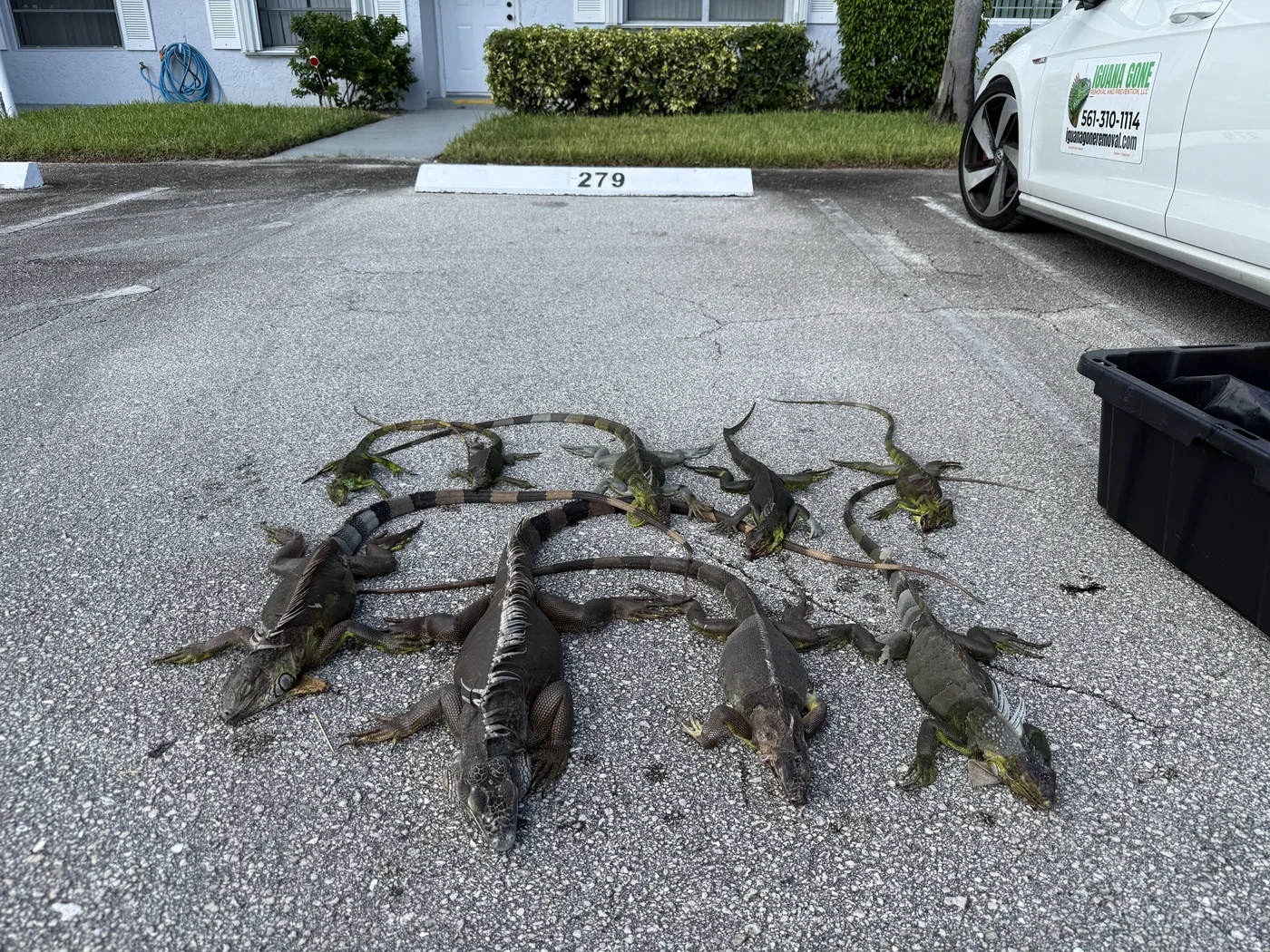
Lake and canal iguana removal for an HOA
At this Delray Beach HOA community, iguana activity was concentrated around the lake and canal. Nine iguanas were removed. The community receives weekly visits under an annual service plan.
Results vary by property, activity level, and site conditions. Ongoing service does not guarantee iguanas will not return.
Delray Beach Neighborhoods Served
- Atlantic Avenue District
- Pineapple Grove
- Marina Historic District
- Old School Square
- Del-Ida Park
- Lake Ida
- Tropic Isle
- Seagate
- Ocean Boulevard
- Kings Point
- Hunters Run
- Delray Dunes
- The Hamlet
- Country Club of Florida
- Mizner Country Club
- Polo Trace
- Gleneagles
ZIP Codes Served
- 33444
- 33445
- 33446
- 33483
- 33484
Delray Beach Iguana Removal FAQ
Do you provide iguana removal in the Atlantic Avenue downtown corridor and Pineapple Grove?
Yes. The Atlantic Avenue downtown corridor (between Swinton Avenue and the Intracoastal) and the Pineapple Grove Arts District north of Atlantic carry steady restaurant-tenant and small-business call volume. We coordinate with the Downtown Development Authority footprint property managers, the restaurant-tenant outdoor-dining tier, and the building-owner contacts on the historic-storefront inventory. Work scheduling fits the corridor's peak dining-and-event traffic windows.
How do you handle iguana work on Delray's barrier-island, beachfront, and A1A estate properties?
The Delray barrier-island strip east of the Intracoastal — Beach Drive, Gleason Street, Andrews Avenue, and the A1A oceanfront tier — runs a private-residential ultra-luxury profile with two-sided ocean-and-Intracoastal frontage on most properties. Coordination runs through homeowner or estate-management contacts, with vehicle staging at back-of-house service positions and discretion-and-access discipline matched to the strip's ownership demographic.
Do you serve Delray Beach's gated communities and country clubs like Mizner Country Club, Hamlet, and Seven Bridges?
Yes. The west-Delray gated tier (Mizner Country Club, the Hamlet Country Club, Seven Bridges, Addison Reserve, Bocaire, Polo Trace, Delaire, and the broader Atlantic Avenue extension gated inventory) is a major focus of our Delray work. For these communities we can coordinate with the property manager, board contact, or approved vendor contact when required, with COI documentation and the per-visit reporting cadence each board specifies.
What does single-visit iguana removal cost in Delray Beach?
$199 for a Delray Beach single-visit residential first-call. Multi-day intensives at properties with established multi-animal patterns run $500. Recurring monthly programs for properties with continuous corridor inflow run $400/month. Restaurant-tenant downtown corridor work, country-club and gated-community programs, and the barrier-island strip estate tier are scoped on the property's specifics. No mobilization, mileage, or after-hours surcharges. Call (561) 310-1114 for a free Delray estimate.
How fast can you respond to a Delray Beach iguana sighting?
Same-day response on most Delray Beach sighting calls. The Boca Raton office (ZIP 33433) puts the Delray radius — Atlantic Avenue, the barrier-island strip, the west-Delray gated tier, and the broader Delray residential footprint — within 10-to-25 minutes. Same-morning emergency dispatch is available for restaurant pre-service windows, downtown event-week pre-event scopes, and country-club and gated-community escalations.
Call (561) 310-1114 for a free estimate. Iguana Gone Removal and Prevention — FWC-listed wildlife specialist serving Palm Beach County.