Professional Iguana Removal in Boca Raton, FL
Trusted iguana removal experts serving Boca Raton residents and businesses. FWC listed wildlife specialist with proven results. We've helped HOAs, golf courses, and homeowners eliminate iguana problems throughout Boca Raton.
Iguana Activity in Boca Raton
Boca Raton sits in one of the higher iguana-density areas along Florida's southeast coast. The combination of a warm subtropical climate (USDA zone 10b), an extensive interconnected canal system, and decades of dense ornamental landscaping has created what biologists would call near-perfect green iguana habitat. The result is that iguanas are no longer occasional visitors here — they are an established, breeding, year-round population that uses Boca Raton properties as primary territory.
The city's geography is a major part of the problem. Boca Raton is bordered to the east by the Intracoastal Waterway, drained internally by the El Rio Canal running roughly north–south through the central core, and bordered to the south by the Hillsboro Canal. Between these major waterways sits a dense web of community and golf-course canals that connect almost every residential neighborhood to a navigable iguana corridor. A green iguana that hatches near the C-15 / Hillsboro can, over its lifetime, swim and crawl its way through this network into golf course communities like Boca West, Broken Sound, and Stonebridge, and from there onto private waterfront homes along the Intracoastal — without ever needing to cross a major road. See our overview of iguanas and canal systems for why these waterways function as iguana highways.
The second half of the problem is what's growing in Boca's yards. The ornamental palette favored by local landscapers and HOA design committees — hibiscus, bougainvillea, croton, ixora, plumeria, schefflera, sea grape, and most flowering tropicals — happens to be exactly what green iguanas eat. Add manicured lawn grass, fruiting mango, papaya, and avocado trees, and a typical Boca Raton property is providing iguanas with a food court they don't have to leave. Read more about what iguanas eat for a fuller picture of why this matters.
The third factor is microclimate. Boca's mature tree canopy, dark asphalt, concrete pool decks, and tile roofs hold daytime heat well into the evening, creating thermal refuges that allow iguanas to stay active during the brief cold snaps that historically would have knocked back populations. The 2010 freeze that killed off large numbers of South Florida iguanas, and the 2022 Christmas cold event that produced the famous "falling iguana" advisories, both had a smaller effect in southern Palm Beach County than in Broward — which is one reason Boca's iguana density has actually grown faster than areas just to the south.
What this means in practical terms: iguana pressure on Boca Raton properties is constant, not seasonal. Sightings spike in March through June during nesting and again in fall when juveniles disperse, but you'll find iguanas basking on pool decks, in mango trees, on seawalls, and on tile roofs in every month of the year. Properties along Lake Boca, the El Rio Canal corridor, the Lake Wyman / Spanish River Park area, the canals through Boca West, the lakes inside Boca Country Club, and the Hillsboro Canal frontage in the south of the city receive the most pressure — but our team has run jobs in every ZIP code in Boca Raton, and there is no neighborhood that is genuinely "iguana-free." The question for every property owner here is no longer whether iguanas will show up, but how quickly and effectively you respond when they do.
Golf Course Community Iguana Control in Boca Raton
Boca Raton may have the highest concentration of private golf-course communities of any city in South Florida. Boca West Country Club alone covers roughly 1,400 acres with multiple courses, hundreds of lakes and canal stretches, and around 3,000 residences — and it is only one of more than a dozen golf communities inside the city. Add Broken Sound, St. Andrews Country Club, Woodfield Country Club, The Polo Club Boca Raton, Boca Country Club, Stonebridge, Boca Grove, Boca Pointe, Boca Lago, and Royal Palm Yacht & Country Club, and roughly one in three Boca Raton residences sits inside a community where iguana management is essentially a shared responsibility between the homeowner, the HOA, and the golf operations team.
Iguanas hit golf-course communities especially hard for three reasons. First, the lakes that ring nearly every fairway are essentially built-in iguana corridors — every course pond is a navigable highway for an animal that swims well and prefers to live within a few yards of water. Second, the lush ornamental beds around clubhouses, pro shops, and home entrances offer non-stop forage. Third, the soft sandy soil along bunker margins, lake banks, and tee boxes is ideal nesting substrate, particularly during the March-through-June nesting peak. We routinely respond to course superintendents who have found dozens of nest cavities along a single shoreline.
The control approach for a Boca golf community has to be coordinated. We work with property managers and grounds crews to map active burrows, schedule trapping sessions around play, and clear iguanas from clubhouses, cart paths, lakes, and adjacent residential lots in a single overlapping campaign. Knowing the signs you have an iguana problem helps managers catch activity early before it spreads across a property, and our HOA iguana control guide explains how multi-property programs are structured. We also document everything in writing for the board's records, so iguana pressure can be tracked from year to year and budgeted for accurately.
For homeowners inside Boca Raton golf communities: the most cost-effective time to act is before damage spreads. A single iguana in your yard usually means more in the lake behind it, and a single nest along the cart path can hatch out 30+ juveniles in late summer. Whether your community already has a contracted program in place or you need to build one, we'll work directly with your management company.
Waterfront Property and Seawall Protection
Boca Raton has more linear feet of seawall than almost any city of its size in Florida. Frontage on the Intracoastal Waterway, Lake Boca Raton, Lake Wyman, the C-15 / Hillsboro Canal, the El Rio Canal, and the dense network of community lagoons and canal cuts means thousands of Boca homes own a seawall — and waterfront properties with seawalls can be vulnerable to burrowing when iguanas are active nearby.
The damage pattern is consistent. An iguana selects a spot at the top of the seawall cap or just behind it, where the soil is loose and softened by irrigation, and digs a tunnel angled back into the yard. Over months, additional iguanas use and expand the same burrow. Inside a year, what started as a single hole can become a network of cavities running 10 to 15 feet behind the wall, hollowing out the soil that holds the wall in place. When that hidden void is finally exposed — usually after a heavy rain washes out a section of yard, or when a section of the cap visibly tilts seaward — the repair bill is no longer a $200 trapping job. Seawall and erosion repairs can become expensive if burrowing damage is ignored, and the deductible on most South Florida homeowners' policies may not cover it. Our article on how iguanas damage roads, seawalls, and canal banks walks through exactly how this undermining develops.
This is why we run a dedicated waterfront seawall inspection on every Boca Raton waterfront job. Our trapper walks the entire length of the seawall, probes suspicious soft spots, identifies active versus abandoned burrows, and looks for the secondary signs — grass settling along the cap, bougainvillea or sea-grape root systems suddenly exposed, irrigation runoff disappearing into a hole — that often appear before the visible collapse. Where active burrows are found, we remove resident iguanas and then collapse and backfill the tunnels. Where evidence of egg-laying is present, we excavate and remove the clutch; a single Boca seawall burrow can contain 30 to 50 eggs. Read more about iguana nesting and egg removal for the seasonality of this work.
For waterfront property owners in Royal Palm Yacht & Country Club, Boca Inlet Colony, the Lake Boca peninsulas, the Camino Gardens canals, and the homes lining the Intracoastal corridor between Spanish River Boulevard and Camino Real — this inspection is one of the most valuable things we do. The cost of an annual or quarterly walk-down is a small fraction of what a seawall failure costs to repair, and the inspection itself is included in our recurring service plans.
Iguana Hot Spots in Boca Raton: Where We Get the Most Calls
After repeated service calls across Boca Raton neighborhoods, certain areas of the city consistently produce more iguana activity than others. Knowing where the pressure is highest helps property owners — and especially HOA boards — prioritize where to act first.
Lake Boca and the Inlet area. The shoreline of Lake Boca Raton, the Boca Inlet, and the homes immediately adjacent (south of Palmetto Park Road, east of A1A) sit on continuous brackish-tidal water with mature mangrove pockets and seawall after seawall. This is one of the highest-density iguana zones in the entire city, and waterfront homes here often see resident iguanas that have lived in or under their seawalls for years.
The El Rio Canal corridor. The El Rio Canal runs from roughly the south county line up through central Boca, paralleling Federal Highway and connecting numerous community waterways. Properties backing onto El Rio — and the side canals branching off it through Camino Gardens, Royal Oak Hills, and the older single-family neighborhoods east of I-95 — show steady, year-round iguana activity that's tied directly to the canal corridor.
Boca West and the central golf-community belt. The clustered golf communities west of Florida's Turnpike — Boca West, Stonebridge, Boca Grove, Boca Country Club, The Polo Club, and Woodfield — share a single connected lake system and produce a steady call volume from spring through fall. Iguanas move between these communities through the connecting waterways and through the open landscape margins along Glades Road and Yamato Road.
Broken Sound and the northeast corridor. The Broken Sound neighborhoods, the waterways around the Boca Raton Resort & Club, and the Spanish River Park area of the northeast quadrant produce another concentration of calls, particularly during nesting season when iguanas leave the water to dig in landscaped berms.
The Hillsboro Canal frontage. Properties along the south edge of Boca Raton, fronting the Hillsboro Canal between Powerline Road and the Intracoastal, sit on a continuous warm-water corridor that runs the full width of the county. Iguana density along this strip is comparable to Lake Boca.
If your property sits in or near any of these zones, you are not imagining the iguana pressure — and the pressure does not go away on its own.
The Boca Raton Microclimate: Why Iguanas Thrive Year-Round
A common question we get from new Boca Raton residents — particularly people who moved down from the Northeast or the Midwest — is whether iguanas die off in the winter. Florida's brief cold snaps are real, and yes, iguanas do go into temporary cold-stunned torpor when air temperatures fall below about 45°F for several hours. That's the phenomenon behind the famous National Weather Service "falling iguana" advisories. We've written more on why iguanas fall from trees for anyone who's seen it firsthand.
But cold-stunning is not the same as die-off, and Boca Raton's microclimate is one of the reasons iguana populations here are so resilient. Three local factors matter.
USDA zone 10b/11a heat retention. Boca sits in a thermal pocket created by the Atlantic to the east and the warm waters of the Intracoastal and the canal network running through the city. Even on cold nights, water temperatures hold in the 60s and surface temperatures recover quickly. Iguanas that enter torpor in the evening often re-warm by mid-morning the next day.
Urban heat retention. Tile roofs, concrete pool decks, dark asphalt driveways, and clay paver patios all absorb daytime heat and re-radiate it slowly through the night. An iguana sleeping under a tile roof or wedged behind a sun-warmed seawall cap is meaningfully warmer than one in a more rural environment just a few miles inland.
Population recovery from the south. When localized cold events do kill iguanas, populations refill from the south within a season. Iguanas from the Hillsboro Canal corridor, from Broward County, and from the warmer micro-zones west of US-1 reproduce and disperse northward, and within 12 to 18 months a previously thinned area is repopulated. This is why every cold snap that gets reported on the news is followed by a quiet summer in which the iguana count returns to where it was.
The takeaway for Boca property owners: do not wait for "the next big freeze" to fix an iguana problem. It is not coming, and even if it did, the population would be back inside two seasons. See our overview of the iguana population explosion in Florida for the broader context.
Iguana Damage to Boca Raton Pools, Pool Cages, and A1A Beach Condo Balconies
Boca Raton's pool environments break into four distinct categories, and the right response on each is different.
The first is the **A1A oceanfront condo balcony**. Boca's barrier-island stretch from Spanish River Boulevard south through Cloister Beach Towers, Sea Ranch Club, Boca Highlands Beach Club, the Addison, Ocean Towers, and the Boca Raton Beach Club has dozens of mid-rise and high-rise condo buildings with planted balconies sitting directly above the dunes. Iguanas reach these elevated balconies by climbing exterior walls, by traveling across adjacent units, or by being introduced through ground-level pool deck planters. Once an iguana settles into a planted balcony with irrigation water and ornamental foliage, it doesn't leave on its own — and on a 30-plus-unit oceanfront building, balcony-by-balcony removal becomes an ongoing program rather than a one-time visit.
The second category is the **estate-property screened pool cage**. Royal Palm Yacht & Country Club, The Sanctuary, The Estates at Boca Pointe, Boca Bath & Tennis, and Lake Rogers Isle homes typically have large screen enclosures covering pool, deck, and outdoor kitchen as a single unit. Iguanas climb the screen frame, push through gaps where the mesh meets the deck, and chew through aging screen at the corner panels. We've removed adult iguanas living inside Boca estate cages for months — protected from predators, with constant access to landscape water, basking surfaces, and the occasional fallen mango. The fix is rarely just removal: it's removal plus a screen-perimeter inspection plus coordination with the homeowner's screen contractor on identified entry points.
The third category is the **country-club shared pool complex**. Boca West, Broken Sound, Stonebridge, Boca Country Club, The Polo Club, Boca Pointe, Woodfield, and Boca Grove all have community pool complexes with deep planted beds, lake-facing seating, and (in many cases) seawall right behind the pool deck. Iguanas treat these complexes as preferred basking habitat — the open deck, the heated water, the lush planting, the absence of dogs. Member complaints about iguanas on the pool deck are one of the most common drivers of HOA wildlife contracts in Boca, and the fix has to be coordinated with the club's grounds and amenity-management teams rather than addressed unit by unit.
The fourth category is the **older single-family residential pool** in Camino Gardens, Royal Oak Hills, Old Floresta, Spanish River, and the eastern Palmetto Park neighborhoods. These tend to be unscreened or partially screened pools sitting under mature ficus, mango, and avocado canopy with dense ornamental beds at the deck edge. The damage pattern is consistent: tail-drag marks across the wet deck, droppings on the steps where iguanas exit the water, and gnawed flower buds in the surrounding beds. See our overview on whether iguanas carry diseases for the sanitation concern that affects all of these environments — concentrated fecal contamination on a wet pool deck or in pool water is a genuine issue, especially in homes with small children or pets.
What every Boca pool job has in common is that the iguana you see is not the only one. By the time droppings appear, the property has typically been on the iguana's daily route for weeks, and there is usually a second animal in the surrounding landscape using the same access route. A pool-focused removal in Boca always includes a perimeter walk to identify the entry points and a recommendation on what to do about them.
Boca Raton HOA, Condo, and Community Iguana Programs
Roughly one in three Boca Raton residences sits inside some form of governed community — Boca West, Broken Sound, Stonebridge, The Polo Club, Boca Country Club, Boca Pointe, Boca Grove, Woodfield, St. Andrews Country Club, the A1A oceanfront condo associations, the Mizner Park residential towers, and dozens of smaller HOAs throughout the central and western neighborhoods. The program that fits a 1,400-acre golf community like Boca West is not the program that fits a 24-unit oceanfront condo on A1A, and the program that fits an A1A condo is not the program that fits a Mizner Park residential tower.
The constant across all of these property classes is shared infrastructure. In Boca, that infrastructure usually includes a community lake or canal segment, a continuous landscape buffer maintained by the HOA's grounds contractor, shared roads with planted medians, and (in the oceanfront and Lake Boca communities) shared seawall or dune frontage. Iguanas don't recognize lot lines drawn on a plat map, which is why removal handled lot-by-lot tends to recycle the same animals across yards rather than reduce the property's overall iguana count. A program that actually moves the needle treats the community footprint as one trap line — one schedule, one set of property-management approvals, one ARB authorization for any prevention work that touches landscape or shared structure, and one set of board-ready documentation feeding into reserve studies, governing-document compliance reviews, and the seasonal newsletters most Boca associations now publish. The pest-control franchises that work primarily off single-customer service tickets aren't structured for this kind of engagement.
Iguana Gone Removal and Prevention has structured a specific program for Boca Raton HOAs and condo associations. It includes a walk-the-property baseline assessment with the property manager or board representative, mapping active iguana sites, burrows, nesting locations, and high-risk seawalls. From there we run a coordinated removal campaign scheduled across all affected buildings or yards in a defined window, rather than house by house. During spring we add egg and nest removal — the single highest-leverage action a community can take to break the population cycle. After the initial campaign, we transition the community to recurring monthly maintenance sized to the property's footprint, with written monthly reporting to the board including iguana counts, removal locations, and recommendations, formatted for board minutes and reserve study planning.
We've worked with management companies running properties throughout Boca West, Broken Sound, The Polo Club, Boca Pointe, Boca Country Club, Stonebridge, and waterfront condo buildings along the Intracoastal. Our HOA iguana control guide explains the program structure in more depth.
For Boca HOA boards specifically: the budget mistake we see most often is treating wildlife removal as an emergency line item rather than a planned annual program. A 200-to-600-unit Boca community that authorizes $400-to-$800 emergency call-outs every time a panicked resident reports an iguana on the seawall ends up spending more across a fiscal year than that same association would have spent on a fixed monthly retainer — and the property still absorbs damage to seawalls, lake banks, and amenity-area landscape in the meantime. The recurring structure is also what makes the board-format reporting and reserve-study integration actually possible, which most Boca master-planned communities now require as part of their governing-document compliance package.
Boca Raton Iguana Seasonal Patterns: When Pressure Spikes and Why
Boca iguana activity has clear seasonal patterns that map directly to specific Boca neighborhoods, waterways, and substrates. Knowing when each window opens helps property owners and HOA boards budget removal correctly.
**Late February through June — the nesting window.** This is the single most consequential period of the iguana year in Boca. Adult females leave the territory they've defended through fall and winter and travel sometimes hundreds of yards to find soft, sun-exposed soil suitable for a deep nest cavity. In Boca, nests cluster in five specific substrates: bunker margins on the Boca West, Stonebridge, Broken Sound, Boca Country Club, and Woodfield golf courses; the soil banks of the El Rio Canal, Hillsboro Canal, and the C-15; the mulched landscape beds at HOA community entrances along Yamato Road, Glades Road, and Camino Real; the planted berms behind seawalls along Lake Boca, Lake Wyman, and the Intracoastal; and the soft soil under historic-district mango and avocado canopy in Old Floresta and Camino Gardens. A single Boca nest cavity holds 30 to 50 eggs, incubates for roughly 65 to 75 days, and hatches a wave of juveniles in late summer. If you only act once during the year, act in this window. Our overview of iguana nesting and egg removal covers the process.
**June through October — hurricane and storm-spike season.** Tropical systems that affect Boca — direct hits, brushes, and even peripheral rain bands from storms tracking offshore — reshape iguana distribution across the city. Storm surge pushes iguanas inland from canal and Intracoastal frontage into central neighborhoods like Camino Gardens, Royal Oak Hills, and the Palmetto Park corridor. Heavy rain saturates burrows and forces iguanas onto roofs, into pool cages, and into trees in numbers we don't see during normal weeks. After named storms we see consistent post-event spikes in calls from the A1A oceanfront condo strip, Broken Sound and Boca West, and the Lake Boca peninsulas — typically within the first 48 hours after the storm clears.
**November through February — the cold-snap window.** Boca's mild winters keep iguanas active most days, but cold snaps below 45°F can produce the well-known "falling iguana" events when torpid animals lose their grip on tree branches and drop. This is rarely fatal — the iguanas wake up disoriented when temperatures rise. The danger is in handling them; cold-stunned iguanas can wake up suddenly and bite (see whether iguanas bite). Boca's cold-snap impact is also smaller than in northern Palm Beach County or inland Broward, because Lake Boca, Lake Wyman, and the Intracoastal hold thermal mass that buffers nearby properties. Population counts recover within a single season after even severe cold events.
**Year-round daily basking and feeding.** Outside of the windows above, iguanas in Boca are visible essentially every month of the year on pool decks, seawalls, mango trees, tile roofs, and golf-course banks. There is no quiet season the way there is for some Florida pests. See our piece on where iguanas go at night for what's happening between sightings.
What to Do When You Spot an Iguana on Your Boca Property
Most Boca homeowners' first iguana encounter is a single sighting — an adult basking on the seawall in Royal Palm Yacht & Country Club, on a screen cage in Boca West, on a pool deck in Boca Pointe, on a Camino Gardens lanai, or on an A1A oceanfront condo balcony. The instinct is to chase it off, and the iguana usually obliges by jumping into the water or running into the landscape. Then it comes back the next day. What you do in the first 24 to 48 hours after that first sighting is what determines whether you end up with a $199 single-visit removal or a $500-plus multi-day intensive.
Three things are worth doing immediately.
**First, document.** A short written note covering when the sighting happened, where on the property the animal was, an estimate of its length, and how many distinct iguanas you've seen in the previous two weeks gives us actionable intel before we ever arrive in Boca. Iguanas run tight daily routines; if your record shows the same large adult on the Royal Palm Yacht seawall every day between 10 and 2, our trapper plans the visit around that window rather than scout the property cold. The signs you have an iguana problem article walks through the secondary indicators worth photographing alongside the animal itself — droppings on pool decks and pool steps, fresh digging at seawall bases or mulch beds, gnawed flower buds, and tail-drag marks across wet pool concrete.
**Second, look for evidence of more than one iguana.** Two or more means the population is growing on your property, which changes the right service approach. Boca's most-reported indicators in order of frequency: droppings on the pool deck or the lanai, digging at the base of seawalls or in the mulch beds at Boca West, Broken Sound, and Stonebridge entry monuments, gnawed hibiscus and bougainvillea, and burrow openings along the El Rio or Hillsboro Canal banks. Two iguanas seen on the same day means the resident population is at least three.
**Third, do not handle the animal yourself.** Adult Boca green iguanas reach five to six feet head-to-tail, weigh up to 17 pounds, have powerful jaws, carry Salmonella, and can leave a serious tail welt. Yes, iguanas do bite when cornered. DIY removal attempts can lead to bites, tail strikes, falls, and other unsafe handling situations, often from grab attempts on cornered adults that move faster than the property owner expected. Skip the retail-store iguana solutions, too. No product sold over the counter in Florida is a legal iguana poison — Florida's animal cruelty statute outlaws every poisoning method anyone has tried to market — and the live cage traps available online have a strong tendency to catch the wrong species. We've responded to Boca Country Club, Boca Pointe, and Royal Oak Hills properties where DIY-deployed traps had captured a neighbor cat, an opossum, and at one Boca Pointe address a young Florida raccoon, while the resident iguana continued to bask on the seawall a few yards away. Mishandled removal also leads to release events that count as a separate FWC nonnative-species violation.
If you live inside Boca West, Broken Sound, The Polo Club, Boca Pointe, Stonebridge, Boca Country Club, Boca Grove, Woodfield, St. Andrews, or any HOA-managed Boca community, also notify your property manager. We can coordinate with property management on community jobs, and your manager can authorize us as the vendor for the work when that's required.
Then call (561) 310-1114. Same-day response is often available for Boca Raton calls, depending on schedule, access, and urgency, and acting on the first or second sighting is dramatically less expensive than waiting until the iguana has nested or brought reinforcements.
Boca Raton Iguana Removal Pricing
For Boca Raton properties, our pricing starts at $199 for a single-visit removal — appropriate for a single iguana on a pool deck, a sighting on the lanai, or a small yard with one or two animals. For properties with established activity, typical of Royal Palm Yacht & Country Club waterfront, Boca West and Broken Sound country-club lots, Stonebridge and Boca Country Club lake frontage, and A1A oceanfront condo balconies, our $500 multi-day intensive runs across consecutive days to catch the cautious second wave that emerges after the bold animals are removed.
For Boca waterfront homes, country-club lots in Boca West, Broken Sound, Stonebridge, The Polo Club, Boca Country Club, Boca Pointe, Boca Grove, Woodfield, and St. Andrews, A1A oceanfront condo addresses, and any property facing continuous iguana inflow from a connected waterway, our $400/month recurring service is the right structure. Includes weekly visits, Lake Boca and Intracoastal seawall checks, nest inspection during the spring nesting window, and proactive removal before populations rebuild.
Commercial work and community-wide HOA engagements in Boca — golf and country-club communities such as Boca West, Broken Sound, Stonebridge, The Polo Club, Boca Country Club, Boca Pointe, Boca Grove, and Woodfield, Mizner Park retail and restaurant tenants, the Town Center commercial perimeter, the Boca Raton Resort & Beach Club, the Royal Palm Place hospitality strip, and the A1A oceanfront condo associations — receive a per-property quote driven by acreage, water frontage, building count, and the reporting cadence the manager or board needs. Boca quotes are flat-rate. We do not bill mobilization, mileage, fuel, or after-hours markup, and we do not bundle in pest-control services that have nothing to do with iguanas.
For service tier comparisons, a full pricing breakdown, and frequently asked questions, see our pricing page. For property owners outside Boca Raton, we serve Delray Beach, Boynton Beach, West Palm Beach, Wellington, Palm Beach Gardens, Pompano Beach, and Deerfield Beach with the same pricing structure.
How Long Does Boca Raton Iguana Removal Actually Take?
The honest answer for Boca depends on which kind of property you have. We work four distinct timelines in Boca Raton, and which one applies to you matters.
**For a single-family residential property** in Camino Gardens, Royal Oak Hills, Spanish River, Old Floresta, or the eastern downtown and Palmetto Park neighborhoods: the bold iguanas come out on the first visit, and a steady low-iguana baseline is usually in place inside the first month to six weeks. The cautious animals — typically females and juveniles — emerge into the cleared territory over the following two to four weeks and are caught on the second-round visits. The variable that decides whether the property holds long-term is what sits beyond the property line. A central-Boca lot with no canal or lake adjacency frequently stays at near-zero iguana count after a single intensive engagement; a lot whose rear yard touches the El Rio Canal, the Hillsboro Canal, the C-15, or one of the community lakes inside Boca West, Stonebridge, or Boca Country Club is going to receive new arrivals continuously, which is why those properties almost always end up on a recurring program.
**For an estate property** in Royal Palm Yacht & Country Club, The Sanctuary, The Estates at Boca Pointe, Boca Bath & Tennis, or Lake Rogers Isle: the timeline is longer because the property is larger, and the screen enclosures, multiple deck zones, and extensive landscape provide more iguana hiding sites. Initial population reduction takes 30 to 60 days; full screen-perimeter inspection and seal-up is layered on top. Royal Palm Yacht waterfront homes specifically will keep receiving new iguanas from the Intracoastal indefinitely — that's the nature of yacht-club waterfront ownership in Boca.
**For an A1A oceanfront condo or beach club building** along the barrier-island stretch (Cloister Beach Towers, Sea Ranch Club, Boca Highlands, the Addison, Ocean Towers, Boca Beach Club, Boca Raton Resort & Beach Club): the campaign focuses on building access points (exterior climbing routes, ground-level pool deck planters, balcony-to-balcony chains) more than on individual animals. Once access points are identified and addressed, balcony iguana counts drop to near zero within 30 days. Without addressing access, removing individual iguanas is whack-a-mole — the next animal climbs the same route within weeks.
**For a country-club community** (Boca West, Broken Sound, Stonebridge, The Polo Club, Boca Country Club, Boca Pointe, Boca Grove, Woodfield, St. Andrews): an honest baseline-reduction campaign across all the affected lots, the connected lake system, the bunker complexes, and the shared amenity areas runs 60 to 90 days, after which the property transitions onto a maintenance cadence sized to its acreage. The March-to-June nesting wave is its own project layered on top of that baseline — egg removal during nesting season is the single intervention with the highest multi-year impact on a Boca golf community's iguana count. See our overview of professional iguana removal methods for why this kind of multi-day pressure schedule outperforms isolated trapping visits.
If a vendor promises you a one-visit, permanent fix on a Lake Boca waterfront property, an A1A condo with active iguana climbing, or a 1,400-acre golf community like Boca West, ask them to walk you through what they plan to do about the next animal that swims in from the Intracoastal or arrives from the connected community lake.
Iguana Prevention for Boca Raton Properties
Prevention work in Boca Raton has to be tailored to the property type — and to the HOA architectural review board (ARB) processes that govern landscape changes in most Boca communities.
**For estate properties and waterfront homes** in Royal Palm Yacht & Country Club, The Sanctuary, The Estates at Boca Pointe, Boca Bath & Tennis, Lake Rogers Isle, and the Camino Gardens canal corridor, the highest-leverage step is screen enclosure maintenance. Boca's large pool cages — covering pool, deck, and outdoor kitchen — typically fail at three points: where mesh meets the deck (gaps from settling concrete), at the door corners (where door operation works the screen loose), and at upper panel seams on aging cages. Annual inspection and patch-up by your screen contractor closes the most common iguana entry routes before they become resident-iguana routes. Trim overhanging mango, ficus, and royal poinciana branches back from the cage, the rooflines, and the seawall.
**For A1A oceanfront condos and beach-club buildings** (Cloister Beach Towers, Sea Ranch Club, Boca Highlands, the Addison, Ocean Towers, Boca Beach Club, Boca Raton Resort & Beach Club), the prevention conversation moves from landscape to architecture. The arrival routes onto an oceanfront balcony are exterior columns climbed up from the pool deck, lateral moves across the railings of neighboring units, and (most often) introduction at ground level through dense pool deck planters that animals then carry up the building. The single intervention an individual unit owner can make that actually changes outcomes is thinning the unit's own balcony planters: a sparse balcony with controlled irrigation is uninteresting to an iguana, and a lush over-planted balcony at altitude is functionally equivalent to a Lake Boca shoreline. For building-wide prevention our scope of work covers ground-floor planter audits, exterior climbing-route assessment with the building's facilities team, and coordination with the master association on shared seawall and dune frontage where applicable.
**For country-club community lots** (Boca West, Broken Sound, Stonebridge, Boca Country Club, The Polo Club, Boca Pointe, Boca Grove, Woodfield, St. Andrews), the highest-leverage step is shoreline management on the community lakes. Softening the lake-to-landscape transition with concrete aprons, riprap edging, or barrier plantings reduces the rate at which lake-resident iguanas migrate into adjacent yards. Many of Boca's country-club HOAs have ARB processes that govern any landscape change, including the iguana-resistant plant substitutions we recommend — we provide written specs and ARB-format documentation on request to make the approval process easier for the homeowner and the board.
**For older single-family properties** in Old Floresta, Camino Gardens, Royal Oak Hills, Spanish River, and the historic eastern neighborhoods, the highest-leverage step is canopy management plus fallen-fruit removal. The 50-to-80-year-old mango, avocado, royal poinciana, gumbo limbo, and ficus canopy in these neighborhoods is also the iguanas' primary highway. Trimming overhanging branches back from rooflines, seawalls, and pool cages closes the most-used access routes. Removing fallen mango, papaya, and avocado fruit weekly during fruiting season eliminates the strongest single attractant a Boca property can produce.
**The baseline checklist that applies to every Boca property class** is short and worth keeping in front of you. Collapse and backfill any open burrow the day you find it — an empty burrow is a vacancy sign for the next iguana that walks the property line. Eliminate the standing-water spots that show up in low corners after irrigation cycles. When you replant a bed, swap out iguana-favored ornamentals (hibiscus, bougainvillea, croton, ixora, plumeria, schefflera, sea grape) for less palatable alternatives like citrus, oleander, milkweed, crotalaria, and most ornamental grasses. And time large landscape installations away from the late-February to June nesting peak. The longer-form checklist lives in our iguana prevention methods guide and what attracts iguanas overview.
Prevention won't replace professional removal on an active infestation, but combined with a recurring service it's the difference between a Boca property that needs constant attention and one that quietly stays at near-zero iguana pressure year after year.
Iguana Removal Laws and FWC Rules for Boca Raton
The legal framework that controls iguana work on Boca Raton property starts at the state level. Under FWC's classification of green iguana (Iguana iguana) as a nonnative invasive species, Boca homeowners and HOA boards do not need a state permit to authorize humane removal from owned land or land they have written permission to enter, and the work can be performed in any month of the year. The constraint is method. Florida's animal cruelty statute (828.12) prohibits poisoning, drowning, freezing, and any other technique that prolongs the animal's suffering — and that prohibition applies even though the species itself is unprotected and considered a regulatory priority for removal. A captured iguana cannot be released back to the wild under any circumstance; it must be euthanized using AVMA-recognized methods on-site, transported live for euthanasia, or handled under a separate FWC permit.
Boca Raton has a few additional considerations worth knowing about. The city's HOA and country-club architectural review processes (Boca West, Broken Sound, Stonebridge, The Polo Club, Boca Pointe, Boca Country Club, Boca Grove, Woodfield, St. Andrews) and the A1A oceanfront condo associations frequently set their own rules about who can perform wildlife work on common areas, on shared seawalls, and on planted balconies — we always coordinate with property management and the ARB on community jobs. Public-land protocols apply to any iguana work near Spanish River Park, Red Reef Park, South Beach Park, the Boca Raton Inlet, and the Lake Wyman / Lake Boca shoreline. Boca's older historic-district neighborhoods (Old Floresta, parts of Camino Gardens) may have additional plantings or landscape considerations that affect prevention work.
For the underlying legal background — agency history, statute citations, the methods AVMA accepts, and what each of the rules actually means in practice for a Florida property owner — our Florida iguana removal laws article is the long-form reference.
Why Choose Iguana Gone in Boca Raton
We're not a national pest-control franchise. Iguana Gone Removal and Prevention is an owner-operated, FWC-listed wildlife specialty company headquartered in Boca Raton (ZIP 33433), and iguanas are essentially all we do. That focus is what makes the difference on a Boca Raton property: when our trapper steps onto your seawall, he is not pulling from a generic rodent-and-termite playbook. He has worked dozens of properties exactly like yours — the same canal systems, the same HOA rules, the same Mediterranean-revival architecture, the same landscaping palettes — and he knows where iguanas hide on them, where they nest, and what it takes to actually clear them out.
Boca Raton property owners also expect a level of professionalism that does not match the dirty-truck, unmarked-uniform stereotype of trapping work. Our team works in clean uniforms, reports in writing, schedules around your tee times and pool service, and respects the privacy and aesthetics of upscale neighborhoods. We have a particular focus on multi-unit communities — Boca West, Broken Sound, The Polo Club, Boca Pointe, Stonebridge, Boca Country Club — where coordinated, building-by-building removal across multiple homeowners is the only approach that actually solves the problem long-term. Single-yard removal in an HOA setting is mostly cosmetic; iguanas just walk back in from the next yard. We've designed our recurring monthly programs and HOA-wide intensive services specifically for this Boca-Raton-style environment.
For Boca property owners, the working relationship runs through the same person from the first phone call through every follow-up visit. Our office is in Boca itself (ZIP 33433), so dispatch is local and our trapper is on your job not because a routing algorithm sent the closest truck but because he's the one who knows the property. On Royal Palm Yacht estate work, on Boca West and Broken Sound country-club lots, on Cloister Beach Towers and Sea Ranch Club balcony programs, and on the recurring HOA accounts we run across the central golf belt, that continuity is what keeps the burrow map and the seawall history accurate from one season to the next. There is no inside sales staff calling you. Estimates spell out the work in writing, and Boca commercial accounts and ARB-coordinated HOA programs receive their monthly board-format reporting without an additional invoice line.
Real Jobs in Boca Raton
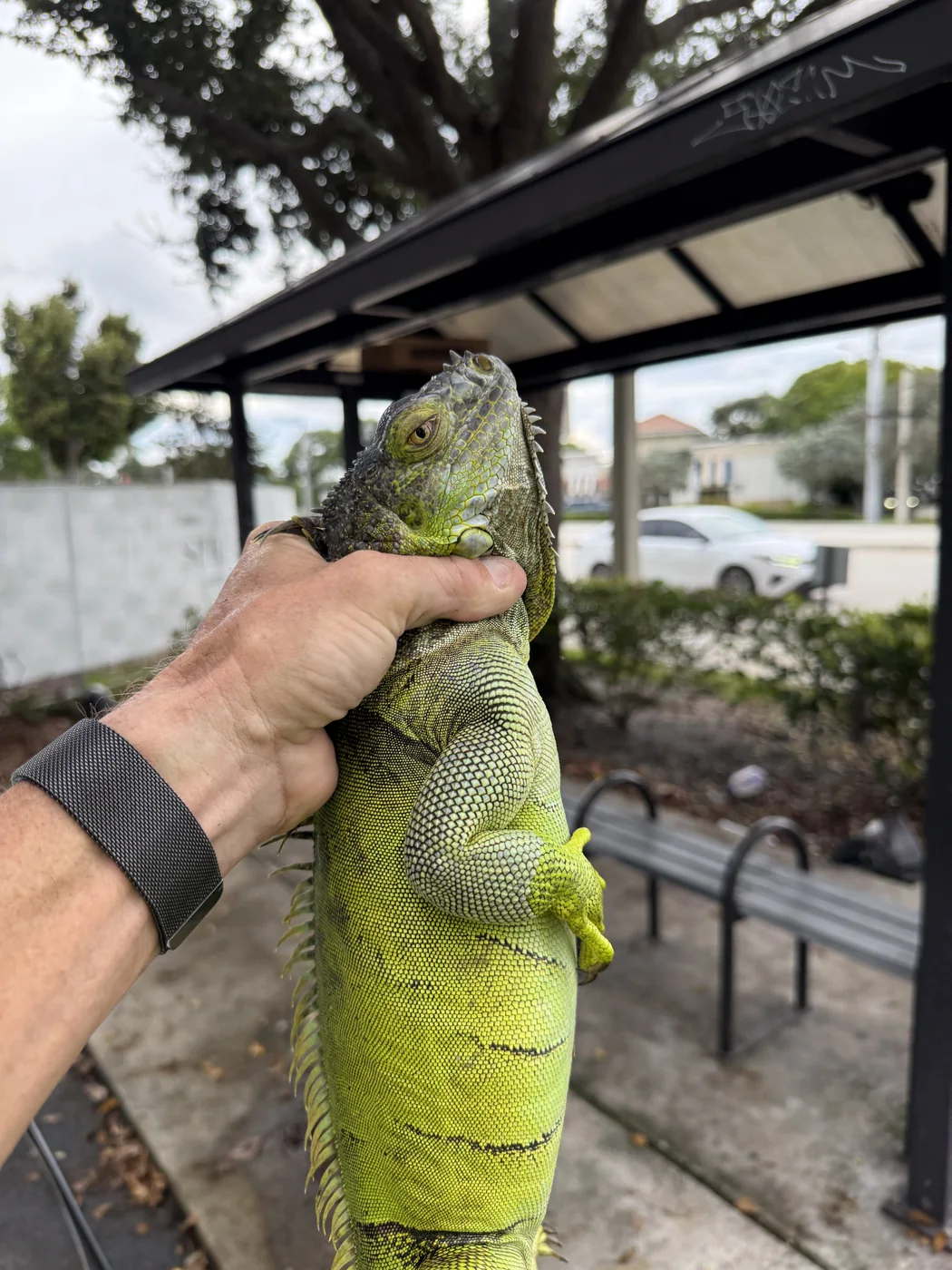
Large iguana captured at a commercial property
Large iguanas were active in the parking lot and on the building at this Boca Raton business. During a weekly visit, a large iguana was caught in the parking lot.
Results vary by property, activity level, and site conditions. Ongoing service does not guarantee iguanas will not return.
Boca Raton Neighborhoods Served
- Mizner Park
- Royal Palm Yacht & Country Club
- Boca West
- The Polo Club
- Woodfield Country Club
- St. Andrews Country Club
- Broken Sound
- Town Center
- Camino Gardens
- Palmetto Park
- Boca Pointe
- Stonebridge
- Boca Country Club
- Boca Grove
- Royal Oak Hills
ZIP Codes Served
- 33428
- 33431
- 33432
- 33433
- 33434
- 33486
- 33487
- 33496
- 33498
Boca Raton Iguana Removal FAQ
Do you serve Boca Raton's tier-1 country clubs like Boca West, Boca Pointe, St. Andrews, Mizner, and Royal Palm Yacht Club?
Yes. Country-club and gated-community properties are a major part of the work we do in Boca Raton. For communities like these we can coordinate with the property manager, board contact, superintendent, facilities contact, or approved vendor contact when required. Per-property scoping typically includes COI, vendor coordination through the property management firm, and per-visit reporting on the cadence the property requires.
How do you handle iguana work on Boca Raton's Intracoastal estate properties and the Boca Raton Resort & Club?
The Intracoastal estate tier (Camino Real, Sanctuary, Le Lac, Bel Marra) and the Boca Raton Resort & Club waterfront tier carry a private-residential ultra-luxury work profile with seawall, dock, and two-sided-frontage scopes. Coordination runs through the homeowner, the estate-management firm, or the resort's facilities contact, with vehicle staging at the back-of-house service positions and discretion-and-access discipline matched to the strip's ownership tier.
What does single-visit iguana removal cost in Boca Raton?
$199 for a Boca Raton single-visit residential first-call. The fit profile is a homeowner's first call without an established multi-animal pattern. Multi-day intensives at Boca-tier properties with established multi-animal activity run $500. Recurring monthly programs for properties with continuous corridor-driven inflow run $400/month. Country-club, resort, and Intracoastal estate properties are scoped on the property's specifics. No mobilization, mileage, or after-hours surcharges. Call (561) 310-1114 for a free Boca Raton estimate.
Are you FWC-listed for iguana removal in Boca Raton?
Yes. Iguana Gone Removal and Prevention is FWC-listed and operates under the green iguana Prohibited Nonnative classification framework (Rule 68-5.007, F.A.C.). We follow Florida's rules for invasive iguana removal and use humane, property-appropriate methods consistent with the animal-cruelty statute (Chapter 828.12), and we document removal activity for property records when needed.
How fast can you respond to a Boca Raton iguana sighting call?
Same-day response is often available on Boca Raton sighting calls, depending on schedule, access, and urgency. Because the office is in Boca Raton (ZIP 33433) — central to Boca West, Boca Pointe, the Intracoastal estate strip, the Camino Real / Royal Palm Yacht Club tier, and the broader Boca residential footprint — many local calls can be reached quickly when scheduling allows. Same-morning service may be available for country-club and managed-community calls and for hosted-event or pre-event scopes that need prompt clearance.
Call (561) 310-1114 for a free estimate. Iguana Gone Removal and Prevention — FWC-listed wildlife specialist serving Palm Beach County.